Feel the Burn! Sensory Illusions for Podiatric Wearables | McGill Shared Reality Lab
Overview
This project explored how thermal sensory illusions can be used to enhance immersion in virtual reality (VR). We designed and built a podiatric wearable that uses thermoelectric modules (TEMs) to simulate temperature changes on the foot, including the thermal grill illusion, where alternating hot and cold stimuli produce a painful sensation.
The work was conducted as part of the McGill Shared Reality Lab (SRL) and investigated how temperature-based feedback could enrich multisensory VR experiences beyond vibration or force feedback.
Motivation & Background
Temperature perception plays a critical role in how humans interpret their environment. Prior work in neuroscience shows that simultaneous activation of warm and cold thermoreceptors can induce strong illusory sensations, such as pain or burning, despite moderate absolute temperatures.
The thermal grill illusion arises from this conflict between thermoreceptor responses and provides a promising mechanism for rendering intense sensations using relatively simple hardware. We hypothesized that this illusion could be reproduced on the human foot, enabling new forms of sensory feedback in VR locomotion and environmental interaction.
Hardware Design
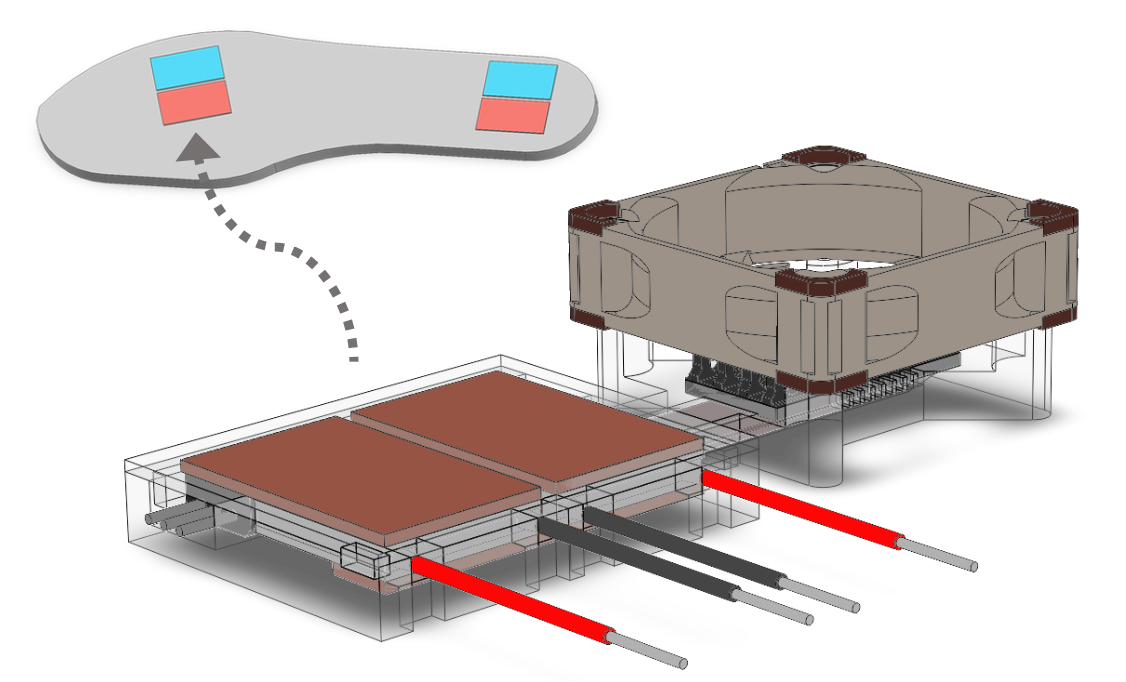
We designed a wearable thermal feedback system integrated into footwear, consisting of:
-
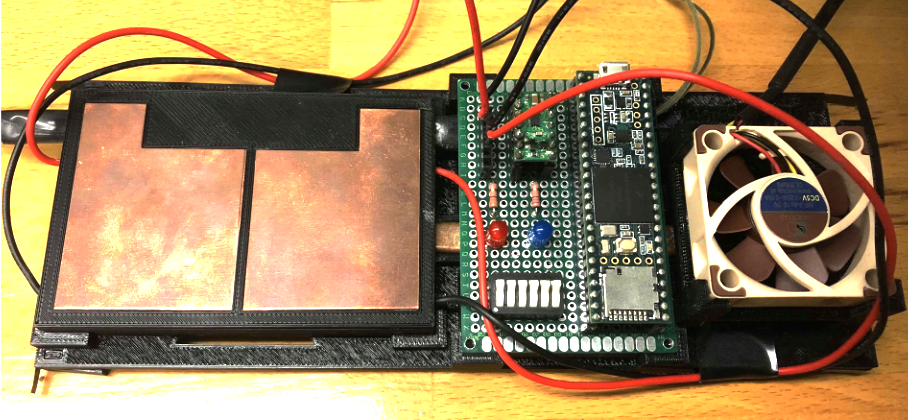
Central control box (1 per shoe)
- Teensy 3.5 microcontroller
- Motor driver for TEM power control
- LEDs and switches for mode indication and manual control
-
Temperature Control Modules (TCMs, 2 per shoe)
- Each module paired one hot and one cold 20 × 20 mm TEM
- Temperature sensors for closed-loop control
- Active cooling via fans, heat sinks, and heat pipes to support rapid temperature changes
-
Mechanical Enclosure
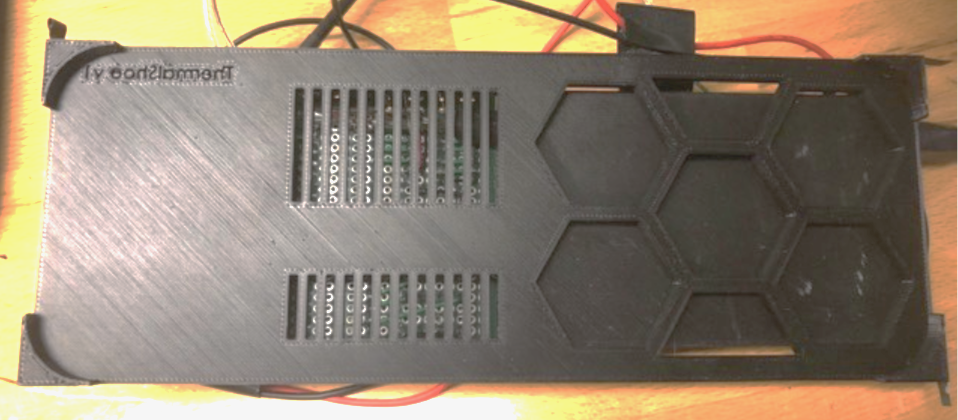
- Custom casing designed in SolidWorks and 3D printed in PLA
- Modular layout to support front and rear foot placement
Control & Modes of Operation
The system supported multiple operating modes:
- Hot (≈ 40 °C)
- Cold (≈ 20 °C)
- Thermal grill (simultaneous hot + cold stimulation)
A hysteresis-based control scheme regulated TEM temperatures under a constant current input. Validation measurements showed that the system could reach the thermal grill configuration in approximately 2 minutes, given power delivery constraints.
Validation & Pilot Testing
Pilot evaluations were conducted with fellow lab members to assess perceptual effects. Observed trends included:
- Thermal grill mode was often perceived as cold, despite the presence of a hot stimulus
- Hot-only mode tended to be perceived as near-ambient
- Sensations were more clearly perceived at the front of the foot than the rear
Future Work
Planned extensions of this work included:
- Improving power delivery to achieve faster heating and cooling rates
- Developing a more portable power solution
- Enabling adjustable placement of front and rear TCMs
- Studying how visual cues in VR influence the interpretation and confidence of thermal illusion perception (ie. bias the pain perception towards burning vs. freezing)
My Role
- Designed the wearable system architecture and TEM-based thermal modules
- Implemented closed-loop temperature control on the Teensy microcontroller
- Designed mechanical enclosures and coordinated hardware integration
- Conducted pilot testing and analyzed perceptual trends
- Contributed to experimental design and future research directions