Study Space Finder | UX Case Study
Overview
This project was completed as part of CPSC 544: Human Computer Interaction at UBC. The goal was to design and evaluate a study space finder to help UBC students efficiently locate suitable study spaces on campus.
The project combined qualitative research, persona-driven design, iterative prototyping, and usability evaluation to address gaps in existing campus space-finding tools.
Problem & Constraints
Students frequently experience difficulty finding appropriate study spaces, particularly during peak hours. Through field research, we identified several limitations in existing solutions:
- No access to real-time occupancy information
- Fragmented workflows across multiple websites (Google Maps, Reddit, UBC official sites, etc.)
- Limited support for informal study spaces such as cafeterias or coffee shops
- Poor usability on mobile devices
The constraints included limited access to real occupancy data and the need to design for both time-constrained and exploratory use cases.
Research & Insights
To understand real study space–finding behavior, we conducted semi-structured interviews and contextual observations with UBC students who had experienced difficulty finding study spaces on campus.
Data Collection
- Participants were interviewed about their study habits, preferences, and existing strategies for finding spaces.
- Contextual observations captured how participants currently searched for study spaces, including their use of websites, maps, and in-person exploration.
- Interviews followed a structured guide and were audio-recorded with informed consent.
- Field notes, observation checklists, and verbatim quotes were collected.
Data Analysis
- Interview transcripts and observation notes were analyzed using NVivo.
- We applied inductive thematic analysis following Braun and Clarke’s approach.
- Codes were derived directly from participant data and iteratively refined through team discussion.
- Quantitative measures (task completion time, errors, perceived difficulty) were summarized using descriptive statistics.
Key Insights
Analysis revealed two dominant user patterns:
- Efficiency-driven users who conduct spontaneous searches and prioritize speed, proximity, and availability.
- Exploratory users who seek variety, ambiance, and richer contextual information about study spaces.
Across both groups, participants consistently reported:
- Reliance on prior knowledge or trial-and-error due to lack of real-time information
- Frustration with switching between multiple tools (library websites, Google Maps, in-person checks)
- Difficulty discovering informal or lesser-known study spaces
These findings directly informed the personas, task models, and system requirements.
Approach & Design
The design process followed an iterative, research-driven approach:
- Defined personas, task flows, and functional requirements based on field data
- Developed a conceptual model centered around familiar metaphors (maps, lists, filters)
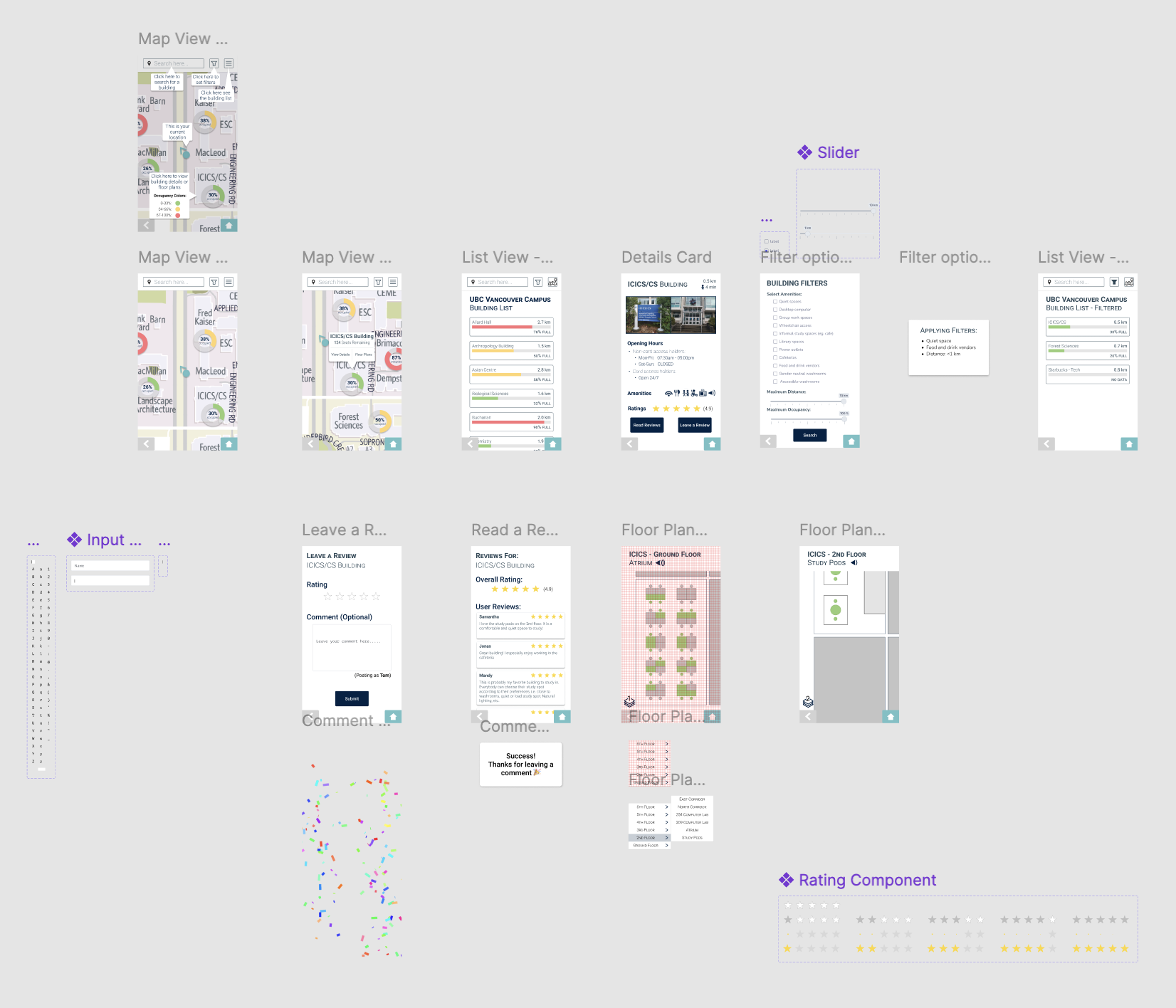
- Designed and iterated on low-fidelity and medium-fidelity prototypes
- Focused on core tasks: checking availability, comparing spaces, filtering by preferences, and reading or contributing reviews
The interaction design emphasized learnability, reduced context switching, and mobile-first usability.
Conceptual Model & Storyboard
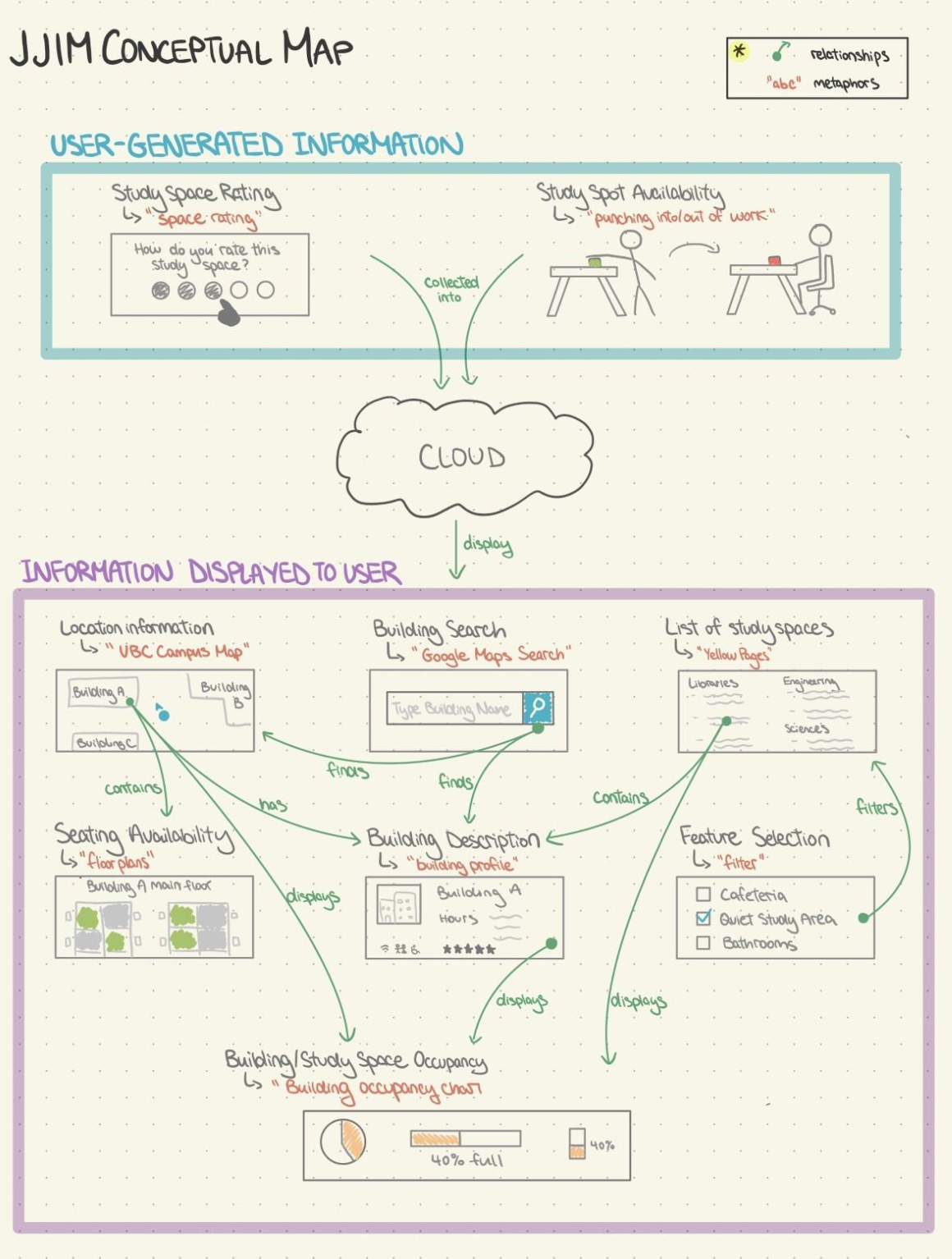
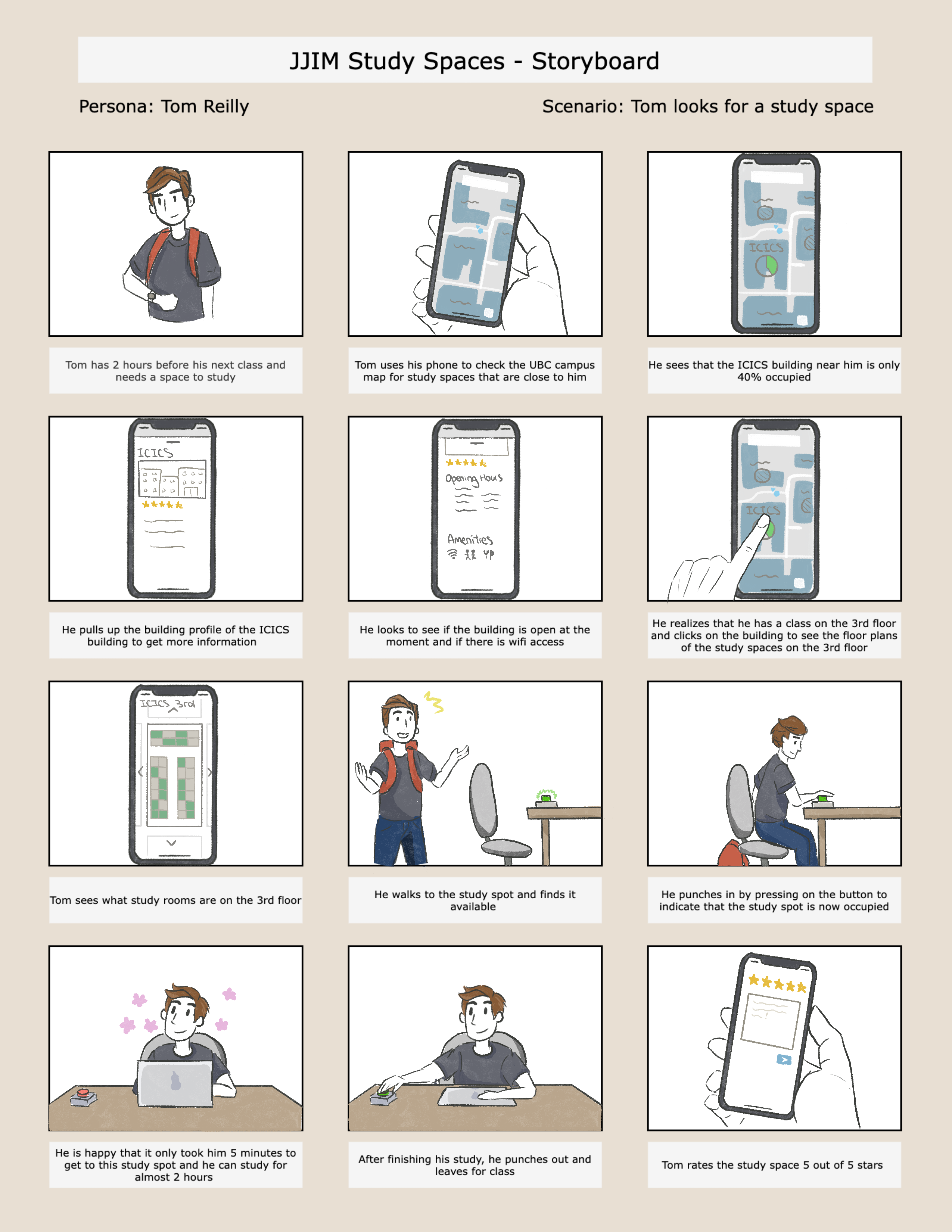
Low-Fidelity Prototypes
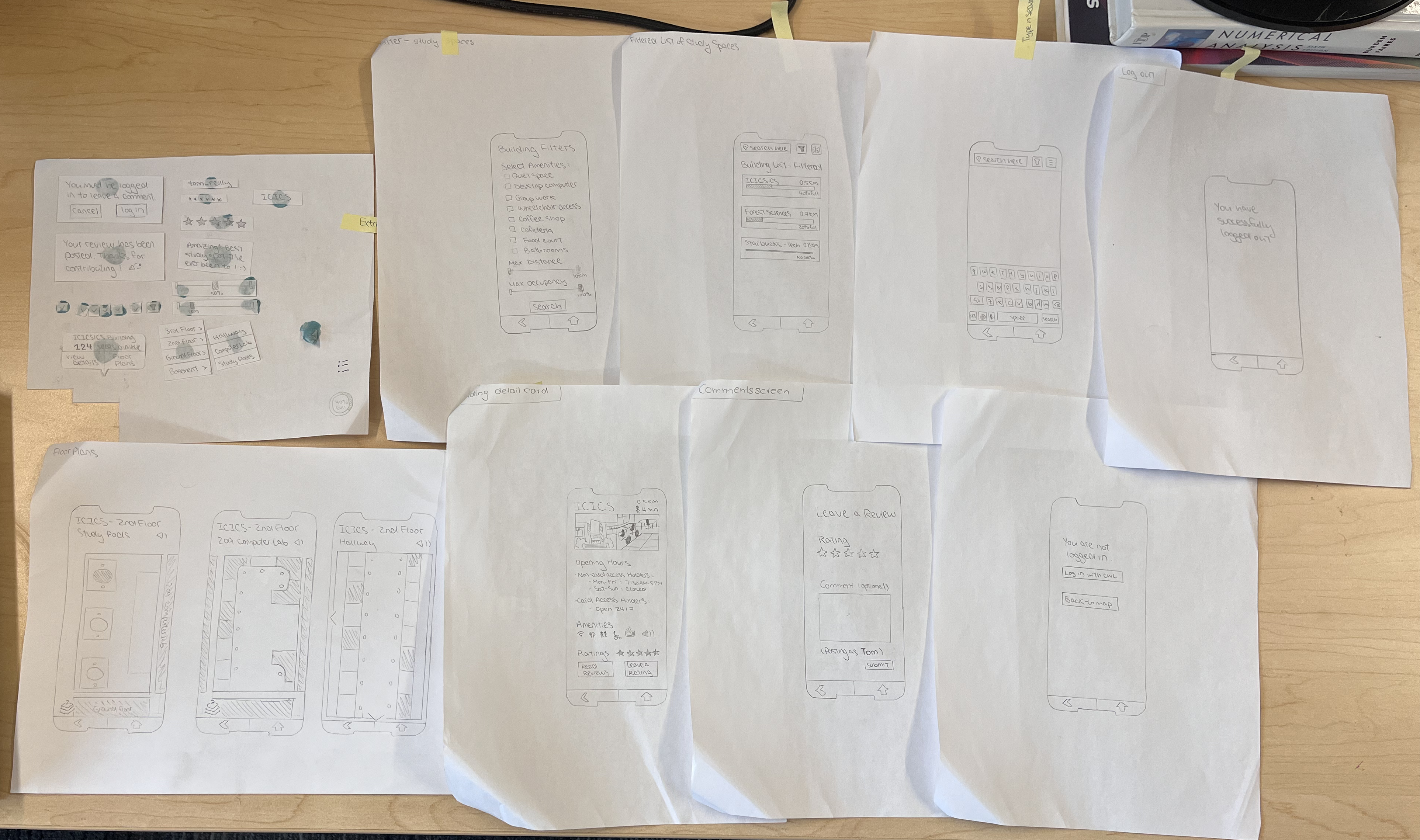
Medium-Fidelity Prototype
Evaluation & Results
We evaluated the low-fidelity prototype through task-based usability testing with representative UBC students.
Method
- Participants completed three core tasks aligned with the main design goals:
- Checking real-time occupancy and available seats
- Filtering and comparing study spaces
- Reading and contributing reviews
- Observations were recorded using structured checklists.
- Metrics included task completion time, error count, clarification requests, and perceived task difficulty (Likert scale).
- Follow-up interviews assessed participants’ understanding of the conceptual model and design clarity.
Results
- Participants completed tasks quickly with few errors, and task performance improved across successive tasks.
- Self-reported ease-of-use ratings increased across tasks, indicating good learnability.
- Users described the interface as intuitive, familiar, and time-saving.
- Real-time occupancy and integrated information were consistently identified as the most valuable features.
Minor usability issues were identified (e.g., filter framing, floorplan discoverability), but these did not prevent task completion and were addressed in subsequent design iterations.
My Role
- Led interaction design across low and medium-fidelity prototypes
- Conducted interviews and contextual observations during field research
- Contributed to persona creation, task analysis, and conceptual modeling
- Participated in usability testing, synthesis of findings, and design iteration
- Collaborated with teammates on design decisions and presentations
This project was developed collaboratively as part of a course team.